

Abstract
The nascent biodiversity market is struggling for concordance and interoperability. Formation of a market will not be possible without the implementation of identical units for price discovery. However, these units require cross-disciplinary approaches from economics, biodiversity science, anthropology, and law.
Here, we present an interoperable, area-based biodiversity unit designed for immediate implementation based on >52 existing biodiversity credit schemas with preliminary cross-market adoption.
The temporal-spatial components of the unit are month-hectare, where one month is defined as 30 days. Each month-hectare is monitored and observed to have a measured integrity defined on a 0-to-1 scale where full integrity is all ecological niches available to, and filled by, native species. Units are categorized with a value grade corresponding to global biodiversity priorities.
Significance statement
The adoption of identical units for biodiversity measurement is a requirement for true price discovery in the emerging commercial and international reporting markets. An interoperable unit will also greatly aid the successful execution of global biodiversity accords.
Acronyms and abbreviations
GBF — Kunming-Montreal Global Biodiversity Framework
IP — Indigenous Peoples
IUCN — International Union for Conservation of Nature
LC — Local Communities
UNEP — United Nations Environment Programme
WWF — World Wide Fund for Nature
Key terms
Biodiversity hotspots: A biogeographic region characterized by exceptionally high levels of species richness and a significant degree of habitat loss. These areas are recognized for their extraordinary concentration of endemic species, meaning species found nowhere else globally.
Components: the elements comprise the biodiversity unit, dimensions (Area, Time, Integrity), and category (Value).
Conservation: There is a technical argument that this methodology falls under the definition of ‘preservation’ in many environmental contexts. “Conservation seeks the proper use of nature, while preservation seeks protection of nature from use." We have used the term conservation throughout for simplicity, and readability with a non-technical IP and LC audience (1)
Ecosystem integrity: An ecosystem is generally understood to have integrity when its dominant ecological characteristics (e.g., elements of composition, structure, function, and ecological processes) occur within their natural ranges of variation and extinction and can withstand and recover from most perturbations.
Ecological services: The benefits people derive from ecosystems.
Ecosystem value: The planet-wide value of an ecosystem in the context of global biodiversity loss. Often referred to as “significance” in other contexts.
Impact: We use the term impact to describe the negative effects on biodiversity from human actions. This is often referred to in different industries as ecological impacts, corporate disclosures, or environmental impact assessments. In the case of the unit, it is meant to represent real impacts on biodiversity and not simply disclosure of these impacts, which are often insufficient or partial.
Methodology: A protocol, often validated by certifiers in open review, with a standardized set of instructions to make meaning out of metrics.
Metric: This means any core measurement. Typically, it involves not only the measurement but also a set of instructions or parameters for the measurement.
Monitoring period: this is sometimes called crediting time, and most projects will have a minimum monitoring timeframe of two years. Restoration projects have longer monitoring periods than conservation projects. Monitoring period is independent of the unit time of 1 month.
Project area: Sometimes called the crediting area and might be segmented for different actions. For most sites, this will be an area greater than 1000ha. The unit does allow for crediting from smaller areas, but many biodiversity actions occur at a sq km (marine science or connectivity studies). The project area is independent of the unit area of 1 hectare.
Species: Group of individuals or natural populations that are actually or potentially interbreeding, reproductively isolated from other similar groups by their physiological properties (reducing incompatibility between parents or sterility of hybrids, or both).
Species richness: The population of different species present in a particular area or ecosystem. It is a measure of biodiversity that quantifies species diversity within a given habitat or geographical region, but it does not speak to the abundance or distribution of the species.
Unit: is a final standardized format for a metric or methodology, such as hectares, or tons, or bushels. For biodiversity, a unit has time, area, integrity dimensions, and a value "grade".
Introduction
Climate change and biodiversity loss
We urgently need an interoperable, global unit of account for biodiversity for all stakeholders to work together to preserve the ecology of Earth.
In the 21st century, Earth is experiencing species loss so abrupt it has been dubbed the ‘sixth mass extinction event’ (2). In 2022, over 196 nations agreed to take urgent action under the Kunming-Montreal Global Biodiversity Framework (GBF), to conserve at least 30% of the Earth’s surface by 2030 — focusing attention on high-risk biodiversity ecoregions to prevent catastrophic species collapse (3, 4). Yet we know from the science of project management and the history of megaprojects that this effort can only succeed if we agree on how to measure our success (5, 6).
Biodiversity accords both lag, and benefit from, lessons learned in carbon accords. While climate is tracked through global average temperature changes, carbon emissions are quantified through metric tons of CO2. As yet, biodiversity action and tracking have suffered because there is no such agreed-upon unit (7).
There is a simple solution to this problem, but the simplicity relies on a frameshift, applying a multidisciplinary approach, and eliminating ideological differences in favor of shared aims.
A rare catalyst for a wicked problem
The emerging commercial market for biodiversity credits has forced a renewed interest in achieving consensus on a biodiversity unit. Economic theory predicts that without a standardized unit of measure, market mechanisms will not achieve accurate price discovery, leading to confusion that will reduce buyer demand (8). But many people flocking to work on this problem are surprised at the need, why hasn’t the unit problem already been solved?
The answer is that the biodiversity unit is what paradox theory and policy science call a ‘wicked problem’, a problem that cannot be resolved through science or data advancements, because the real conflicts are about values, interests, and perspectives (9).
Yes, biodiversity has all the regular technical headaches for natural systems science. Complexity in measurements and data, path dependence (unlike carbon, biodiversity will always be localized to the context or ecosystem where it evolved), unknowns of species themselves, and messy ontologies (10–12). However, these problems are exacerbated by deeper conflicts between the stakeholders who need to use a biodiversity unit (Nature, notably, is not among them — merely needing to tangibly benefit from a unit’s application).
Charities dominate the current $81 billion biodiversity market, but commercial interests and innovation dominate the $180 billion emerging biodiversity credit market, competing both ideologically and for public and/or private funding for biodiversity protection and uplift (13, 14). Indigenous Peoples have 80% of the conserved biodiversity but are unified in their dislike of quantifying or commercializing Nature and as yet undecided on biodiversity markets — although they have been clear in their disdain of the way carbon markets have unfolded (15–18). Governments are committed to tracking and regulation but have an estimated $700 billion finance gap to execute on biodiversity goals, and have failed to achieve any timely or meaningful regulation on carbon (3, 19). Industry currently extracts an estimated $7.3 trillion dollars annually from natural capital and has few incentives to fund a reversal of this behavior (20). Corporations profiting from biodiversity loss are legally bound to maximize that profit, and yet claim to be paradoxically self-regulating — even possibly leading regulation through voluntary cutbacks like the Taskforce on Nature-related Disclosures (21)? It is clear that a biodiversity unit must work for all of these parties, yet none of them parties share values, interests, or perspectives. In fact, quite the reverse.
In management science, paradox theory is used to address and tame wicked problems with high tensions (22). So how do we “measure what matters” for biodiversity when we can’t agree about what matters?
Political science tells us that some of the tools to solve a wicked problem are to: 1) identify it accurately, 2) treat the problem as unique, 3) avoid science- and data-driven solutions in favor of negotiation, and 4) reduce the compounding factors of complexity, uncertainty, and disagreement (9).
The emerging market for biodiversity credits has created a rare opportunity to solve this problem by aligning stakeholders, thus reducing disagreement, because every stakeholder could potentially use a well-designed marketplace. Many parties see an opportunity to iterate on the working model of the carbon market while solving some intransigent problems with biodiversity funding and climate equity (14). Certainly, government funding for climate and forests is not currently reaching Indigenous Peoples (23), and we know that commercial innovation is better at optimizing markets (24). However, the disciplines of history, law, and political science are clear on the risks of using capitalistic structures to innovate in fields that need to be protected ethically or for minority groups (25).
Therefore, the ideal biodiversity unit will be useful in a commercial or charitable market, protect equity to the extent possible, and function immediately to capture this rare opportunity for concordance. We’ll address the requirements in turn, and then discuss a negotiated area-based unit that is achieving market traction.
Technical requirements for an area-based biodiversity unit
A unit is an abstraction that enables rapid communication about a standardized measurement. Trade is built on units — as are the physical sciences, and the rest of modern society. Identical units are a prerequisite to the formation and efficient functioning of markets.
Both carbon and biodiversity are emerging markets. We know from research on innovation that emerging or frontier markets stabilize and form according to a standardized curve of the Gartner Hype Cycle (26). In this context, carbon markets would be at the “trough of disillusionment” stage, and biodiversity markets would be at the “innovation trigger” stage. The speed with which any market achieves optimization or “productivity” is dependent on several factors, one of which is perfect competition.
The main principles of perfect competition are that products or services in the market are exchanged in terms of identical units, the market is large enough that no single participant has influence over the pricing, there are no barriers to entry or exit for market participants, and all market participants have complete information available (8). The absence of any one of the conditions for perfect competition results in price distortion and market failure, rather than optimal value and wealth creation (27).
In the ideal market, all activity is measured in terms of standardized identical units in order to avoid inefficiencies and support buyers in comparing the relationship between price and value. But the current biodiversity market more closely resembles a yard sale, with boutique purchases and individuals haggling (28). Currently, the number of proposed biodiversity ‘units’ numbers nearly as high as the number of active schemas which is currently fifty-two and increasing daily (29, 30).
Therefore, a viable unit would need to reliably work for at least the majority of these schemas, all stakeholders, and also accurately abstract path-dependent data (ecosystem-specific data) for a global context (30). In particular, it would need to function in measuring conservation, restoration (pollination, uplift, eradication of invasive or alien species), and impact (disclosures of degradation or avoided degradation) actions.
As most of these schemas explicitly or implicitly intend, in order for the biodiversity credit market to utilize similar market structures as the carbon credit market, it must also be a commodity (28). Commodities markets have rigorous regulations regarding product expiration and universal tangibility and do not accept scoring systems and calculations that do not have real-world corollaries. They could, for instance, sell one ton of live meerkats with a ‘grade’ of 4.5, but they could not sell 4.5 stars that had been awarded to live meerkats. The first is a physical dimension, the second is an intangible score whose value is arbitrarily based on the reputation of the awarding party.
This is not such a bad requirement. Human concepts mean nothing to Nature, which is nothing if not tangible. Thus, the more tangible a unit is, the more likely it is to truly measure, and account for, natural systems. Reduced abstraction also leads to reduced opportunities for gaming or manipulating a unit from its intended use.
There remains some debate around area-based units. While there are certainly biodiversity actions which fall outside of area-based activities, the vast majority of schemas can utilize an area-based structure. Certainly, one could argue that biodiversity never exists outside of an ecosystem, or habitat. Therefore, an area-based unit could cover the emerging market adequately with the stipulation that future units may emerge.
Ideally, a properly designed unit will also be aligned with the International Sustainability Standards Board (ISSB) accounting standards International Organization for Standardization (ISO) Guidelines and a number of emerging international market controls on natural capital accounting (31, 32).
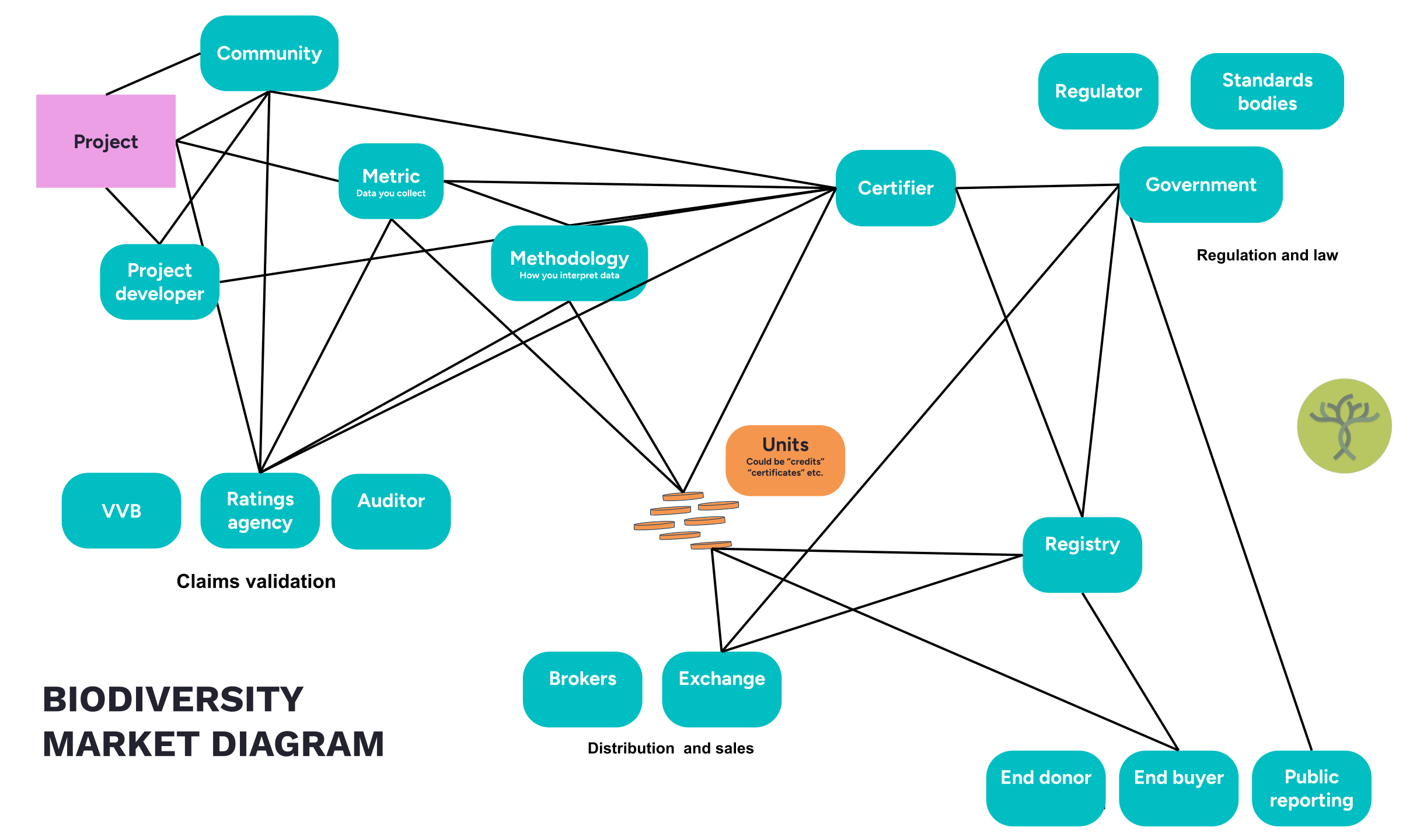
Currently, carbon commodities markets have a multi-party structure, which is rapidly replicating itself for biodiversity markets (30). A clear understanding of this structure dramatically reduces common technical confusions about the unit, which is too frequently conflated with other market functions and structures such as validation of claims, standardization of metrics and methodologies, price, sales, and origination (see Figure 1 and Discussion).
Social requirements for a well-designed unit
As discussed earlier, approaching the biodiversity unit as merely a technical problem will not lead to a solution. Climate change and Indigenous equity are two well-recognized wicked problems, in the biodiversity unit they compound with existing technical problems (9). We cannot simply solve, we must negotiate.
The biodiversity unit is not only an economic problem, but also a historical, sociological, anthropological, political, and legal one. A universally abstracted unit must cross paradigms between the industrialized, and non-industrialized worlds, and protect non-human species as entities with the inherent right to exist. Not least, it must function in accounting for Nature in regulatory, charitable, and commercial contexts during a profound transition of economic and legal models formerly built on colonialism and extraction. As the Intergovernmental Panel on Climate Change reported in 2022, colonialism and inequity are primary drivers of the vulnerability of ecosystems and people to climate change, and also a chief barrier to recovery (33). This task is impossible when viewed through competing ideological lenses; unifying principles must be found.
Conventional economic theory must adapt to address markets where the majority of the supply is controlled by groups that don’t transact via conventional economic mechanisms, or where we want to adapt these mechanisms because they have historically inflicted severe harm (34).
Indigenous Peoples are both a critical stakeholder and shareholder in negotiating a proper unit for embryonic biodiversity markets. The UN and World Bank estimate they control 80% of the intact biodiversity on the planet (35). Together with local communities, they account for 30% of the intact planet and own or manage nearly half of the world’s forests and farm landscapes (36–38).
Yet they are a minority, numbering only six percent of the planet’s total population while accounting for a disproportionate 19% of its population living in extreme poverty (39). Thus, despite international rights to consultation and direct involvement in the design of markets that affect them, they are often underrepresented or excluded from market negotiations and require special protections (17, 40). Indeed, trade with IP is protected in a separate category with unique protocols under international law and local Indigenous governing structure and dimensionality that may not conform to Western systems (41).
Both IP and LC are also worth consulting for technical reasons. They have better long-term outcomes for forest management (42), protect biodiversity effectively in sovereign lands (43), and comprise essential knowledge, expertise, and impact for the preservation of species (44). Further, LC, if not directly incentivized, are the greatest risk to habitat destruction (45).
However, we must acknowledge existing markets have failed in inclusion and equity. IP and LC currently receive less than 1-2% of the funding from existing climate markets (38, 46). Our best current evidence shows that trade and market-based schemes have made little impact against deforestation, and in some cases worsened economic inequality (40, 47).
If colonialism caused climate change, we must address the two issues as linked (33). A unit that is intended to meet GBF aims must be intuitively acceptable to IP and LC, remediate or ameliorate economic inequality, and take advantage of non-industrialized technical expertise. We propose that a successful unit transcends three core paradigms: tangibility, dynamism, and anthropocentrism.
A tangible unit is not only good for commodities markets, tangibility is also better at achieving value in both industrialized and non-industrialized paradigms. We know from the disciplines of philosophy and anthropology that epistemology, axiology, and ontology vary widely between industrialized and non-industrialized cultures (48, 49). For instance, an intangible unit like a ton of carbon computed from a forest study immediately leads to a dearth of IP or LC specialists on the topic and requires intermediaries versed in this kind of epistemological knowledge (e.g. allometric equations and satellite forest modeling) (18). In contrast, a ton of goji berries might require as much depth of expertise to deliver, but both industrialized and non-industrialized world can easily conceptualize, measure, and trade it. There is no reason a biodiversity unit must be intangible (e.g. calculated score from machine learning algorithm) instead of tangible and measurable by both epistemic cultures (e.g. a hectare of intact ecosystem).
Larger area-based units also allow for dynamism. Conceptualizations of biodiversity as an object to be traded belie its dynamic qualities. In contrast, IP often have living-systems perspectives that are relational, or praxis-based. One simple way to resolve this apparent discrepancy is not to reduce units for biodiversity below that of functional units for an ecosystem.
IP perspectives also adjust for anthropocentrism. Many proposed units reward anthropocentrism by measuring biodiversity in terms of human priorities (human scoring systems, human effort, commodification of ecosystem services or land cost) (30). In contrast, IP initiatives explicitly demand that biodiversity cannot be judged around its value to humans, it must be measured from the perspective of an intrinsic right to exist (50). Further, units which prioritize uplift or threat over conservation or intactness will have profound effects on both resource allocation to Indigenous Peoples and fail to reward Nature within its own context. Thus, a well-designed unit must account for the possibility of legal rights of Nature, different paradigms of animal ownership and/or custodianship, and measure biodiversity based on outcomes for all species, not only humans.
As a final consideration, there is no doubt that area-based units transacting through commercial structures do run the risk of exacerbating existing inequities in land rights. But this problem, while important (and wicked), cannot be resolved or addressed at the level of a unit, and must be accounted for in other social and/or governance mechanisms (see Figure 1).
The unit
We present a unit negotiated and adopted multilaterally over a two-year period between Savimbo (an Indigenous-led B-corp), their Indigenous friends (greater than ninety Indigenous leaders in 25 countries, and 55 Indigenous nations), and market representatives from academia, regulatory bodies, corporate governance, project developers, certifiers, and more.
As discussed above, insurmountable scientific, social, trade, and accounting problems are resolved cleanly for biodiversity when re-contextualized to tangible dimensions and naturalized to perspectives of other species.
We propose the result as an interoperable unit, aligned with ethical considerations with/from/for/by Indigenous Peoples and the rights of Nature, and deployable for GBF targets in any context (commercial, regulatory, or philanthropic).
The key to an interoperable area-based biodiversity unit lies in the pragmatic selection of universal elements (ie, space and time) to the smallest functional units attributable to an ecosystem, and intelligent normalization of non-universal elements (ecosystem integrity and comparative ecosystem value).
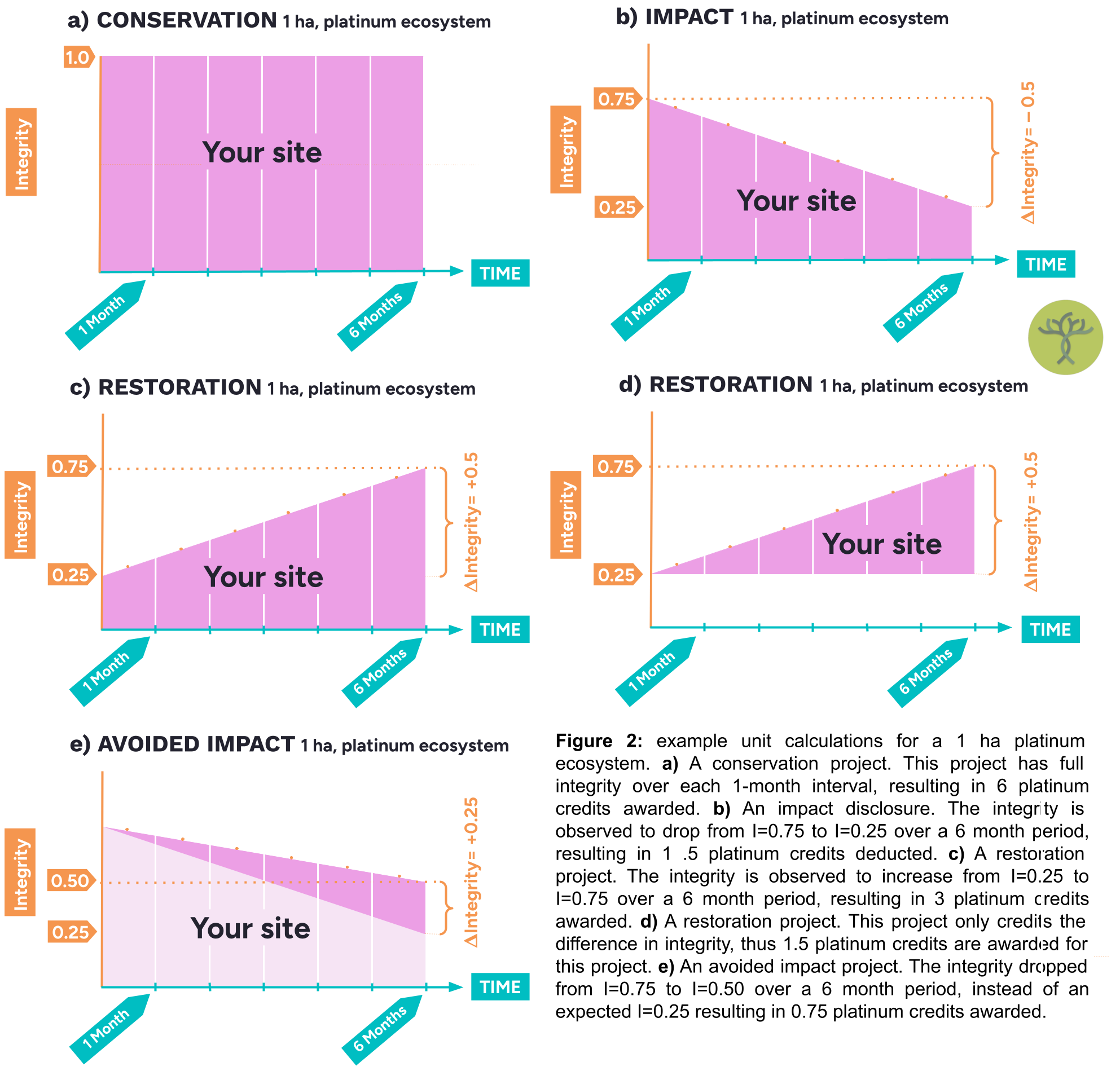
Thus, this unit measures a functional ecosystem, with standard dimensions for area, time, and integrity, and a categorical value. This unit works for any ecosystem, metric, or methodology and covers conservation, restoration (pollination, eradication, or uplift), impact reporting, and avoided loss activities (see Figure 2).
This unit is restricted to area-based activities, excluding activities such as genetic conservation, legal or collective actions in favor of biodiversity, human-wildlife conflict mitigation, etc. We do not attempt to describe these with the unit presented in this paper, nor do we attempt to propose another unit to fit these types of conservation, as it is outside the scope of this paper.
The unit describes an area (1 hectare) for time (1 month = 30 days) with measured integrity (scale from 0 to 1, as determined by bespoke methodologies) categorized by its value (Platinum, Gold, Silver, Bronze). It can be applied to any area-based biodiversity action, including conservation, restoration, impact, or avoided impact scenarios.
A complete explanation of these components follows.
Area
The standardized area of this unit is always 1 hectare. Marine biodiversity science and connectivity projects are usually expressed in larger areas such as square kilometers, but these can be easily converted to smaller units. Some schemas use meter-squared areas, but these were rejected as too small to be a minimum functional ecosystem unit.
Time
The standardized time of this unit is always 1 month. While most ecologists and some impact buyers preferred time dimensions of one year, the majority of traders and market analysis stated that maximum granularity was optimal for market adoption. After significant negotiations, it was decided that the maximum granularity achievable was one month, and bespoke users could easily issue 12 credits for a year.
Making time more granular serves two purposes, market adoption on commercial commodities markets and data integrity of scientific reporting.
At the time of unit release in 2024, public market pricing for carbon commodities units averaged ($0.45-$7/ton) (51, 52). Meantime, bespoke methodologies were averaging over-the-counter pricing of ~$30-200/ha/year for conservation, and $300-1000/ha/year for land restoration (53). Granularity was required to speed commodities market adoption and access existing traders, lowering the price to mimic current carbon pricing, units then ranged from $2.50 to $16.60/ha/mo for conservation and $25 to $83/ha/mo for restoration, closer to existing pricing for carbon (see Discussion).
Scientifically, there was no barrier to this change. Just as the area of a project can be reported in hectares, the time of a project can be reported in 30-day intervals. Shorter timescales for a unit do not affect project durations which averaged 10 to 20 years, or monitoring periods which averaged 1 to 5 years. For instance, a typical restoration project requires a twenty-year commitment, monitoring at three- to five-year periodicity. However, monthly units do allow for more accurate quantification. As shown in Figure 2, shorter units can report biodiversity fluctuations in a quantized fashion.
Integrity
Ecosystems are complex systems. Under complexity theory, an ecosystem has the properties of historicity and path dependence; being unique, it can only be compared to itself (54). However, the comparison is generalizable.
The disciplines of ecology, biology, and biodiversity science have robust tools for calculating area–based gains in integrity — what is variably known as ecological integrity/intactness or ecosystem health (55). This abstraction works for every ecosystem, and there are currently greater than 52 bespoke schemas that allow for efficient quantification of this dimension (28, 29).
The generalization problem solved, all that remains is to standardize the reporting scale. The standardized integrity scale for this biodiversity unit ranges from 0-1. Where zero integrity (0) signifies a completely degraded ecosystem, for example, nuclear waste sites, ocean dead zones, and wildfires that burn hot enough to sterilize soil. And where full integrity (+1) is defined as all ecological niches, available to, and occupied by, native species. In other words a fully available ecosystem, including fully preserved primitive areas, national parks, game parks, UNESCO World Heritage sites, primary Amazon forest, etc.
Full integrity is not directly measurable. One of the characteristics of complex systems is that they cannot be fully quantified (56). However, it is estimable by localized metrics and methodologies (i.e. desert, ocean). Conservation, eradication, pollination, restoration, and corporate impacts from all ecosystems can abstract outcomes within this scale.
Value
Value is the planet-wide benefit of preserving the ecosystem where the hectare of the unit is located.
One of the moral debates that makes the biodiversity unit a wicked problem is the endless argument about whether humans have the right to value Nature. The authors of this paper consider this issue a moot point. First, we already value Nature by extracting it silently for a $7.3 trillion dollars annual profit (20). Second, valuation schemas already exist and have been widely applied (see Table 1). Last, the unit proposed is for use in GBF accords, which most of the world agrees are important to achieve, and which have a 700 billion finance gap (3) — prioritization of targets will occur actively or passively.
Certainly, not every ecosystem is created equal. Applying biogeochemistry science to look at the planet as an organism, some ecosystems are organs (a liver or a kidney), and some ecosystems are muscle, skin, or bones (57). Internationally there is agreement that triage is necessary, directing resources in order of planetary importance (3, 4).
One key reason to include a value layer is that with additionality requirements pristine and unique ecosystems that are not under imminent threat of logging, mining, or land clearing may not otherwise be eligible for biodiversity crediting. A value layer allows their inclusion while accurately delineating threat for buyers who require it to act.
Furthermore, some of the most important and critically endangered ecosystems have inverse political representation or funding, especially if they are in the Global South (4, 17). Without separate value and integrity calculations, primary forest in the Amazon would trade undifferentiated from rehabilitated farmland in Western Europe or the USA. Lower-value (bronze, silver) ecosystems also typically cover larger land areas. Therefore, crediting projects could foreseeably be much larger in area, and thus are eligible for a greater number of total credits.
Regardless, many stakeholders in the biodiversity space may choose to ignore value categorizations for ethical reasons. As valuing nature is a human activity, not fundamentally associated with its inherent characteristics Value is a category, not a dimension of a biodiversity unit.
Value for this unit is determined by public data on global ecosystem value and threat from thirteen reputable public classification schemas (See Table 1.), simplified and normalized into 4 categories Platinum, Gold, Silver, or Bronze for interoperability and market adoption. Where Platinum is generally high-threat, high-density, Gold is high-density, Silver is higher than average density, and Bronze are remaining sites.
This dataset is incomplete. Even the most respected organizations (International Union for Conservation of Nature (IUCN), National Geographic, Biodiversity hotspots, World Wildlife Fund (WWF), and United Nations Environmental Program (UNEP) among others) have partially characterized datasets, although it is to be hoped that directing more funding to biodiversity over the coming years will assist in this endeavor. We therefore strongly recommend that value should not be maintained by a commercial market, and requires independent, unbiased maintenance with adequate representation of global stakeholders.
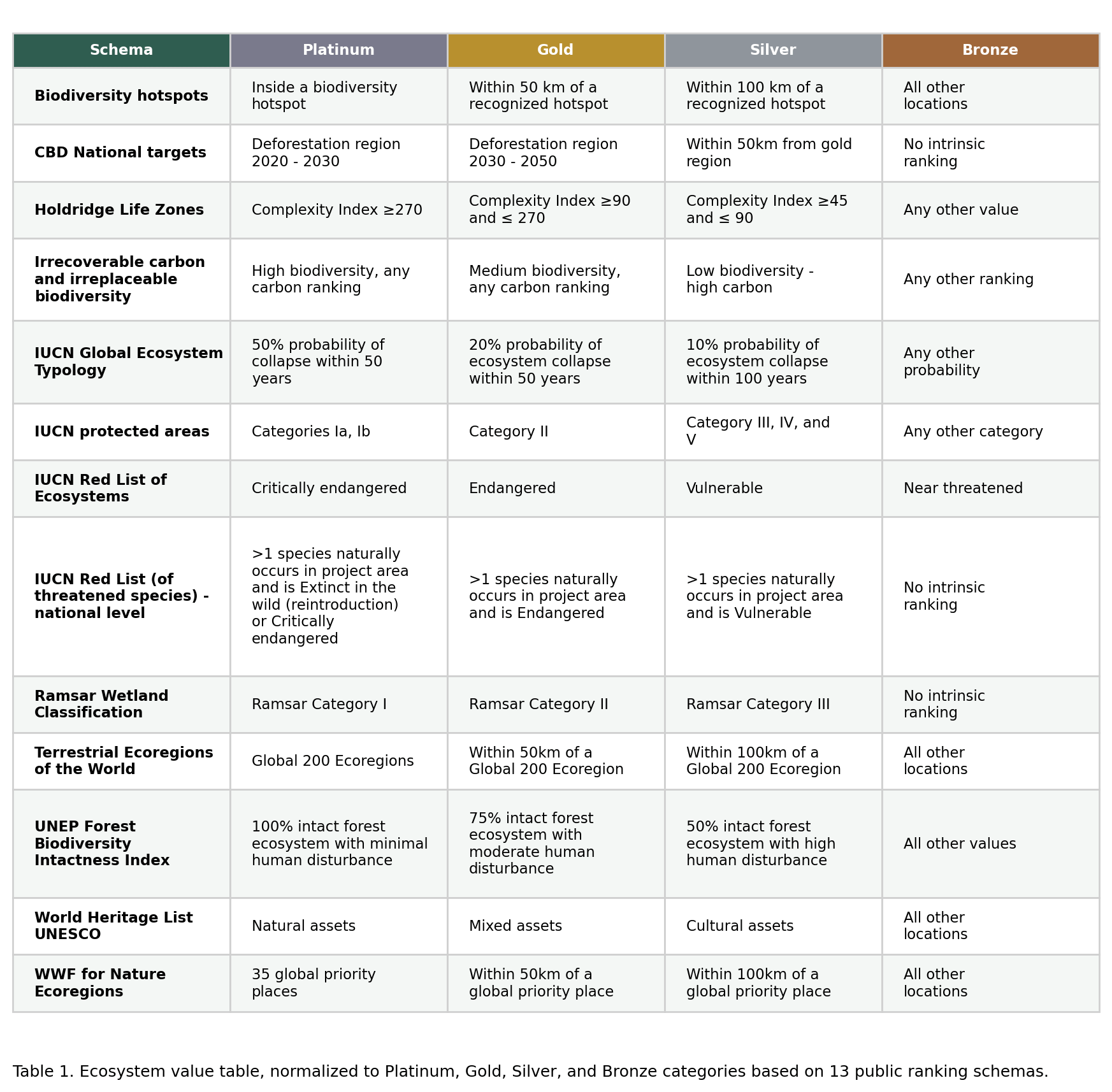
Table 1. Ecosystem value table, normalized to Platinum, Bronze, Silver, and Gold categories based on 13 public ranking schemas.
Integrity vs value
It is critical to distinguish between the two data layers of integrity and value. The first is a dimension of reality which makes the unit tangible; the second is a human-assigned category. Mistakenly, conflating the two is one reason the biodiversity unit has been technically complex, a problem compounded by ideological differences.
The integrity of a hectare of ecosystem is based on how authentically it is expressed, its full health, or comparing like for like. The value of the ecosystem, representing the intrinsic biodiversity density of that region and the threat of degradation, is determined by geographical location, and compares unlike ecosystems. They are independent components, you can have high integrity/low value, or any other variation of the two.
Areas near high-value ecosystems (forest outside of a biodiversity hotspot), or high-density ecosystems that are not threatened (Amazon with low deforestation rates) could have full integrity, but will have a lower value category. Degraded areas within high-value ecosystems, (eg. cattle farms inside a biodiversity hotspot) could be high value, but would have low integrity. Making this distinction is important as it places financial pressure on returning high-value ecosystems in biodiverse regions to full integrity, and shifts farming practices to more abundant and less biodiverse regions. Unique biodiversity hotspots under threat from mining, logging, and agriculture will be supported by greater financial incentives.
Schemas that conflate these two data layers do not properly differentiate unit attributes for stakeholders. For instance, some biodiversity credit buyers only want to buy from threatened ecosystems (classic carbon additionality criteria), while some philanthropic donors fund across all threat levels in high-biodiversity zones. Some funders will only fund uplift (increased integrity) while others will only fund conservation (maintained integrity) with little interest in the underlying value of the ecosystem.
Calculation of a biodiversity credit
Calculations for generating biodiversity units from a methodology must be methodology-specific. A unit simply gives standardized dimensions for the final output. A simple example of a unified calculation formula follows, which may be further modified by area-based methodologies.
Where a indexes the one-hectare unit areas that make up the project area, A. Where t indexes the one-month unit time that covers the total monitoring period T, and the first unit time is t=1, which indexes a one-month period. Note that biodiversity units can only be summed if they have the same Value.
As shown in Figure 2, this calculation is interoperable for all area-based conservation, restoration, and corporate disclosures.
The formula above is sufficient for conservation projects. By definition, restoration projects monitor actions that lead to positive changes in integrity. As the unit time is short, it is reasonable to simply credit the integrity in each successive month of the crediting time. However, some methodologies may choose to subtract a baseline integrity when they credit. If so, the mechanism to update that baseline from one crediting period to another must be clear for fair crediting.
For calculations, Integrity is taken as constant throughout a one-month unit time period, and rapidly changing integrity must be averaged over this time. Changes in integrity are reflected over the full monitoring period of the project, subdivided into one-month crediting intervals.
Discussion
In summary, the interoperable biodiversity unit presented in this paper takes advantage of a timely opportunity to solve a wicked problem. By comparing an ecosystem to itself (like for like), we resolve the problem of uniqueness within, and abstraction between, ecosystems. Then all that remains is to standardize area and time to the smallest intuitive functional dimensions to solve economic problems with pricing and granularity.
Global interoperability enables conservation funding and other resources to be directed precisely where they need to go, based on the value of each unit which is dictated by the global free-market and independent authorities on planetary targets.
Now we cover many common conflations between the unit, and the concepts related to it.
Biodiversity vs carbon
There is considerable conflation between carbon markets and biodiversity markets. Carbon markets certainly have had problems with a lack of credibility, transparency, double counting, and equity (58). But, they always had a universal unit, a ton of carbon. Biodiversity markets can iterate on carbon-market failings, but the unit problem is a separate problem, and conflation between the two issues has delayed the design and adoption of an appropriate unit.
Where possible, we have incorporated lessons learned from carbon market failings in the selection of negotiable unit attributes and Indigenous co-design. However, the majority of unit decisions were constrained by logic, pragmatism, and multidisciplinary theory. The main reason we were able to clearly elucidate these constraints was to remove issues that were irrelevant to the discussion (see Figure 1).
The most powerful tool we had in negotiating this unit, was the willingness to leave intractable, but irrelevant debates out of the discussion.
Unit vs metric
Metrics are the first level of scientific abstraction. A metric is any core measurement, which usually has a scientific protocol for standardization. It typically includes not just the measurement itself, but a set of repeatable instructions or parameters. For example, the “diameter of a tree at breast height” is the core metric in almost all forest carbon estimates. Everything else is calculated from this raw data with standardized instructions in obtaining the metric, and extrapolated with allometric equations for scale.
In biodiversity, “species observation” might be a metric, but identifying a species is very different with different protocols depending on the kingdom (insects, trees, fish, etc.) or ecosystem (identifying dolphins in the ocean is different from sand crabs on the beach). Raw data, like game-camera footage, is converted into a metric like a species observation, through a formal process that controls for taxonomy, natural variation, DNA vs phenotypes, and species evolution. Other metrics of biodiversity have been proposed (such as eDNA testing of water), and local Indigenous people use their own metrics (such as the taste of the bark of an Amazonian tree). Both are highly accurate chemical tests, but practically impossible to correlate to one another.
It’s useful, but not essential, to use metrics and units that can be understood by different cultures across industrialized and non-industrialized paradigms. We do recommend metrics that meet cross-cultural epistemological requirements - prioritizing game cameras over eDNA. What is essential is that metrics are abstracted sufficiently for global markets, while retaining accuracy.
Metrics are constantly evolving with technology and scientific developments. The aim of this paper is not to constrain metrics, but instead to differentiate between metrics which are useful for market purposes (cleanly generate an accurate unit) and those which are useful for scientific purposes (measure ecosystems in other ways).
Much of what has made the unit debates intractable is the attempt to standardize metrics, which are desirably heterogeneous, instead of providing a comparable format for their final abstraction. This paper does not constrain metrics, it merely asks if metrics can be used in an ecosystem unit or not.
Unit vs methodology
Methodologies are the second level of scientific abstraction. A methodology is a protocol to make meaning out of metrics. The methodology chosen by researchers, often validated in open review, is a protocol to measure and quantify the biodiversity of a particular ecosystem, usually using a combination of metrics in a formal abstraction. In the biodiversity crediting market, these methodologies are technical documents that explain how to generate biodiversity credits. Once a methodology is published, the methodology can be used by projects worldwide to calculate their credits. Some methodologies have certification from companies that provide certification of biodiversity credits. Most methodologies are ecosystem-specific and constrained by action (i.e., a methodology for increasing pollinators in farmland).
Not all crediting schemas will use methodologies, some may credit from metrics alone. But in all cases, methodologies are independent of the final comparable abstraction, the unit, and merely clearly describe how the unit was calculated and from what metrics and with what justification.
Much of what has made the unit debates intractable is the attempt to prioritize one methodology over another, which are desirably heterogeneous, instead of providing a comparable format for their final abstraction. This paper does not constrain methodologies, it merely asks them to report their output in a final abstraction, an interoperable unit.
Unit vs price.
A unit is not a price. A price depends on the buyer-perceived market value at the time of sale (related to, but not to be conflated with, the Value category in this paper). This includes the perceived market value and reputation of each project developer, certifier, methodology, metric, ecosystem, action, and even charismatic species involved in unit composition.
As already described, units need to be logical and tangible in their composition. However, buyers do not have to be rational in pricing. In fact, the field of behavioral economics tells us they are likely to be quite irrational (59). Indeed, early market pricing for restoration is already nearly triple that of conservation, and inverse to species density, showing anthropomorphic buyer motivations (4, 53).
Furthermore, IP have been clear in many contexts that they do not believe biodiversity has a price, or it is priceless. And many abstain from putting a price on biodiversity no matter how it is measured.
Our task, in this case, is merely to design units that accurately reflect biodiversity itself. Not to promote pricing or value judgments on biodiversity.
We did bow to current market pricing in our choice of area/time granularity. Preferring the smallest functional ecosystem unit of hectare/month over alternatives such as sqkm/year. But this decision will not affect final market pricing for biodiversity, which will be based on market normalization in the future. Fluctuations in the price of the credit, or the price of land a credit is associated with, do not affect the unit it is measured in.
Unit time vs. monitoring time
The time component of the unit was chosen as one month (30 days) for minimum viable granularity. Larger monitoring periods (duration of crediting periods, methodology requirements, etc.) can be easily subdivided into smaller time intervals for conversion to this unit.
Controls and requirements for monitoring period length fall outside the scope of the unit design and must be accounted for by methodologies, certification bodies, international standards, and verifiers (see Figure 1).
Much of what has made the unit debates intractable is the option to select from a wide variety of seemingly arbitrary scales for standardizing time (month, year, twenty years) and area (hectare, acre, meter-squared). The point of a unit is to make a logical choice that makes intuitive sense to people who will use the unit, stick with it, and obtain stakeholder consensus around that choice. And this is what we have done.
Unit vs verification/validation
Methodologies, metrics, and units may be audited by independent parties in order to validate claims about biodiversity outcomes. Indeed, we recommend third-party validation. However, the validity of reported units and the comparability of reported are completely separate issues. The authors of this paper can all claim to be ten feet tall, and the truth of this claim does not affect the tape measure used to measure our height (see Figure 1).
We do note that making units tangible and simple greatly reduces the opportunity for manipulation of reporting, and this was a strong consideration in unit dimensions.
Unit vs market
This biodiversity unit does not have to be used as a commodity or transact in a marketplace. A unit that meets the requirements for a commodity has advantages in tangibility, market adoption, and accounting for expiration (biodiversity is either alive or dead) (28). However, given the strong presence of charitable stakeholders in this space, one could argue that an effective unit cannot only be commercial (13). It is preferable if this unit is used interchangeably across commercial and noncommercial settings. This unit can be also called a biodiversity ‘credit’, ‘certificate’, ‘asset’, or any other semantic variation as long as they are identical dimensions.
Much of what has made the unit a wicked problem is the endless debate about the commercialization of Nature, a highly emotional argument. In turn, the solution is to use it as a measurement across philosophical divides.
A note on offsetting
Biodiversity offsetting is the practice of compensating ecosystem degradation by providing ecological protections elsewhere. A biodiversity unit is a unit of measurement. While the authors of this paper cannot constrain its use in offsetting, the authors of this paper are opposed to offsetting for the following logical reasons.
While the efficacy of carbon offsetting is hotly debated, carbon is a basic element and can circulate atmospherically between ecosystems, and from ‘desirable’ to ‘undesirable’ states (58). Biodiversity is alive, unhealthy outside of the ecosystem it evolved in, and cannot circulate across ecosystems and between life and death. A living pool must be maintained; extinction is a forever event.
The practice of biodiversity offsetting directly contravenes the values and rights championed by Indigenous Peoples as well as the legal precepts of emerging Rights of Nature legislative frameworks (17).
Conclusion
The key to this unit’s interoperability lies in the fact that standardizing time, value, and area, allows methodologies and metrics to converge on a standardized integrity measurement from the perspective of the ecosystem itself. The integrity metric accounts for path dependence (a characteristic of complex (i.e. natural) systems) by comparing the ecosystem to itself (like for like).
This standardized integrity is critical to the interoperability of the biodiversity unit, allowing the evolution of market-based value comparisons and price determination based on principles of perfect competition, while accounting for the uniqueness of biodiversity credits’ origin.
Bibliography
C. D. Becker, K. Ghimire, Synergy between traditional ecological knowledge and conservation science supports forest preservation in ecuador. CE 8 (2003). Link
J. C. Briggs, Emergence of a sixth mass extinction? Biological Journal of the Linnean Society 122, 243–248 (2017). Link
E. Dinerstein, et al., A Global Deal For Nature: Guiding principles, milestones, and targets. Sci. Adv. 5, eaaw2869 (2019). Link
S. Pironon, et al., The global distribution of plants used by humans. Science 383, 293–297 (2024). Link
J. Doerr, Measure What Matters: The Simple Idea that Drives 10x Growth (Penguin UK, 2018). Link
B. Flyvbjerg, D. Gardner, How Big Things Get Done: The Surprising Factors That Determine the Fate of Every Project, from Home Renovations to Space Exploration and Everything In … (books.google.com, 2023). Link
L. Heagney, et al., “The cost of biodiversity - what nascent biodiversity markets are telling us” (Aton Consulting, 2024) (June 8, 2024). Link
D. Shapiro, D. MacDonald, S. A. Greenlaw, Principles of Economics. Principles of Economics (2022). Link
B. W. Head, Wicked problems in public policy. Encyclopedia of Public Policy (2023). Link
M. A. Huston, G. Marland, Carbon management and biodiversity. J. Environ. Manage. 67, 77–86 (2003). Link
P. van Oosterzee, The integration of biodiversity and climate change: A contextual assessment of the carbon farming initiative. Ecol. Manag. Restor. 13, 238–244 (2012). Link
N. Salafsky, et al., A standard lexicon of terms for area‐based conservation version 1.0. Conserv. Biol. (2024) https://doi.org/10.1111/cobi.14269. Link
OECD, “A Comprehensive Overview of Global Biodiversity Finance” (OECD, 2020). Link
T. Cox, WEF: Biodiversity credit demand could reach $180 bln by 2050 in radical future. Carbon Pulse (2023). Link
Indigenous Environmental Network, Call for input 2023 - Meaningful engagement of Indigenous Peoples and local communities in Article 6.4 mechanism (2023) (February 28, 2024). Link
E. S. Gualinga, Emil Sirén Gualinga on LinkedIn: GBF_Biodiversity_Markets. Emil Sirén Gualinga on LinkedIn: GBF_Biodiversity_Markets (2024) (May 8, 2024). Link
BCA, Recommendations on Biodiversity Credits of the Community Advisory Panel (CAP) of the Biodiversity Credit Alliance (BCA):Discussion Paper for Consultation (2024). Link
Global Forest Coalition, “Who really benefits? How REDD+ fails forests and those who protect them” (Global Forest Coalition, 2024). Link
United Nations Environment Program, “Emissions Gap Report 2022” (United Nations, 2022). Link
Trucost, “Natural capital at risk: The top 100 externalities of business” (Trucost, 2013). Link
R. Panwar, T. Leib, S. Federman, M. Betts, Reimagining the Role of Business in Protecting Biodiversity. Stanford Social Innovation Review (2024) (June 7, 2024). Link
J. Schad, P. Bansal, Seeing the forest and the trees: how a systems perspective informs paradox research. J. Management Studies 55, 1490–1506 (2018). Link
M. Owen, S. Allnutt, A. Corriveau, J. Hatcher, Funding with Purpose A STUDY TO INFORM DONOR SUPPORT FOR INDIGENOUS AND LOCAL COMMUNITY RIGHTS, CLIMATE, AND CONSERVATION (2022). Link
W. J. Baumol, The Free-Market Innovation Machine: Analyzing the Growth Miracle of Capitalism, 5th Ed. (Princeton University Press, 2014). Link
Y. T. Jabareen, Toward Participatory Equality: Protecting Minority Rights under International Law. Isr. Law Rev. 41, 635–676 (2008). Link
X. Chen, T. Han, Disruptive Technology Forecasting based on Gartner Hype Cycle in 2019 IEEE Technology & Engineering Management Conference (TEMSCON), (IEEE, 2019), pp. 1–6. Link
J. Robinson, What is perfect competition? Q. J. Econ. 49, 104 (1934). Link
S. Gradeckas, Biodiversity Credits: Assets or Commodities? Bloom Labs (2024) (May 16, 2024). Link
S. Gradeckas, Biodiversity Markets: Predictions & Thoughts for 2024. Bloom Labs (2024) (February 28, 2024). Link
S. Gradeckas, Biodiversity credit schemes database. Bloom Labs (2024) (May 7, 2024). Link
International Organization for Standardization, ISO/CD 14054 Natural Capital Accounting for Organizations. International Organization for Standardization (2024) (May 12, 2024). Link
International Sustainability Standards Board, Climate-related Disclosures | ISSB (2023) (May 11, 2024). Link
P. R. Shukla, J. Skea, A. Reisinger, R. Slade, “Summary for Policymakers” in Climate Change 2022 - Mitigation of Climate Change, Intergovernmental Panel on Climate Change (IPCC), Ed. (Cambridge University Press, 2022), pp. 3–48. Link
A. Kothari, A. Salleh, A. Escobar, F. Demaria, A. Acosta, Pluriverse: A Post-Development Dictionary (Tulika Books, 2019). Link
C. Sobrevila, “The Role of Indigenous Peoples in Biodiversity Conservation” (World Bank, 2008). Link
J. Stewart, “Territories of Life: A global spatial analysis of the estimated extent of territories and areas conserved by Indigenous peoples and local communities,” C. Corrigan, H. C. Jones, L. Vairi Zanjani, J. Rubis, Eds. (World Bank, 2021). Link
L. V. Zanjani, et al., Territories of life as key to global environmental sustainability. Current Opinion in Environmental Sustainability 63, 101298 (2023). Link
UN Food and Agriculture, “The state of the world’s forests 2022” (UN Food and Agriculture, 2022) (May 19, 2024). Link
World Bank, Indigenous Peoples Overview. World Bank (2023) (May 23, 2024). Link
N. Perry, Market-based schemes not reducing deforestation, poverty: Report. Phys.org (2024) (May 15, 2024). Link
United Nations, Declaration on the Rights of Indigenous Peoples. 53, 32 (2007). Link
R. K. Pokharel, Indigenous forest management practices in some community forests of Nepal. Banko Janakari 10, 37–39 (2017). Link
A. Blackman, P. Veit, Titled amazon indigenous communities cut forest carbon emissions. Ecological Economics 153, 56–67 (2018). Link
A. Estrada, et al., Global importance of Indigenous Peoples, their lands, and knowledge systems for saving the world’s primates from extinction. SCIENCE ADVANCES 8, 1–19 (2022). Link
P. Buys, K. M. Chomitz, G. D. De Luca, T. S. Thomas, S. Wertz-Kanounnikoff, At Loggerheads?: Agricultural Expansion, Poverty Reduction, and Environment (World Bank, 2006). Link
J. Hatcher, “Falling Short,” D. Yin, Ed. (Rainforest Foundation Norway, 2021) (May 17, 2024). Link
D. Kleinschmit, C. Wildburger, B. Fisher, “International forest governance: A critical review of trends, drawbacks, and new approaches. ” (International Union of Forest Research Organizations (IUFRO), 2024). Link
C. R. Hale, Activist Research v. Cultural Critique: Indigenous Land Rights and the Contradictions of Politically Engaged Anthropology. can 21, 96–120 (2006). Link
D. Foley, Indigenous methodology: Is it invented or is it legitimate?. Journal of Australian Indigenous Issues 21, 20–38 (2018). Link
J. Gilbert, E. Macpherson, E. Jones, J. Dehm, “The rights of nature as a legal response to the global environmental crisis? A critical review of international law’s ‘greening’ agenda” in Netherlands Yearbook of International Law 2021: A Greener International Law—International Legal Responses to the Global Environmental Crisis, Netherlands yearbook of international law., D. Dam-de Jong, F. Amtenbrink, Eds. (T.M.C. Asser Press, 2023), pp. 47–74. Link
Xpansiv, Xpansiv Public Website Trades. Xpansiv (2024) (June 9, 2024). Link
Emsurge, Emsurge VCM Daily Update (2024) (June 9, 2024). Link
K. Burkhart, Personal communication (2024).
P. A. David, “Path dependence in economic processes: implications for policy analysis in dynamical system contexts” in The Evolutionary Foundations of Economics, K. Dopfer, Ed. (Cambridge University Press, 2005), pp. 149–194. Link
Wildlife Conservation Society, FAQ: Ecosystem Integrity in the Post-2020 Global Biodiversity Framework (2019). Link
K. Resnicow, R. Vaughan, A chaotic view of behavior change: a quantum leap for health promotion. Int. J. Behav. Nutr. Phys. Act. 3, 25 (2006). Link
P. J. Boston, “Gaia Hypothesis” in *Encyclopedia of Ecology *, Second Edition, B. Fath, Ed. (2008), pp. 86–90. Link
P. Delacote, et al., Strong transparency required for carbon credit mechanisms. Nat. Sustain. (2024) https://doi.org/10.1038/s41893-024-01310-0. Link
D. Kahneman, Maps of Bounded Rationality: Psychology for Behavioral Economics. American Economic Review 93, 1449–1475 (2003). Link
Authors
James Paynter PhD1, Ana Isabel Lopez2,3, Alvaro Vallejo4, Nawi K. Flores5,6, Enrique Balp7, Andrea D. Burbank MD2,8*,
Author contributions:
J. Paynter led the writing of the article, assisted by all authors. All authors reviewed, revised, and approved of the final article. A. Burbank, A. Vallejo, A. Lopez, E. Balp, N. Flores, and J. Paynter conceptualized the topic. All authors contributed to research design.
Funding and Support: This research was financially supported by funding from Savimbo Inc., and contributions by its authors. Note: The article contents are solely the responsibility of the authors and do not necessarily represent the official views of the affiliated or sponsoring institutions.
Conflict of Interest: Savimbo Inc. is a social enterprise which sells biodiversity credits, and has a biodiversity methodology that sometimes earns royalties when other people use it. Andrea Burbank is CEO of Savimbo Inc., Ana Lopez is an employee of Savimbo Inc. Alvaro Vallejo is the International Carbon Registry Biodiversity Program Lead. The other authors have no competing interests.
Human Subjects Statement: No human subjects were involved in this research.
Acknowledgments: Miguel Chindoy, Enrique Balp-Straffon, Roberto Duif, James Pittman. Grace Rachmany, Jhony Lopez, Michal Krawczyk, and Fernando Lezama. The independent Indigenous leaders panel working with Savimbo.
Author’s note
Science is not a social club. This paper was written by an astrophysicist (published in Nature) and an MD (published in Science). We know how to write science papers.
The ideas were also tested before they were written down. Over a year of drop-in, ad-hoc working groups, 99 Indigenous leaders challenged and debated them.
Several journals have still refused it, while publishing multiple opinion pieces arguing the problem has no solution. It isn’t the writing. So it’s the topic, the co-authors, or the conclusions.
The stated reason is usually that it falls between social and mathematical science. It isn’t observational research, and it isn’t opinion. It’s closer to a proof, in an ecology topic. There was no category for it, just as there hasn’t been a multidisciplinary solution to the problem.
So here it is, open-source and machine-readable. We’ll keep submitting (we know the game). There’s no reason to hide actual work in the meantime.